
Digital Collage (Fresque du Numérique): How It Works, and Which Alternatives for Sustainable IT Awareness?
By Clément Lemerle, published on , updated on
Contents
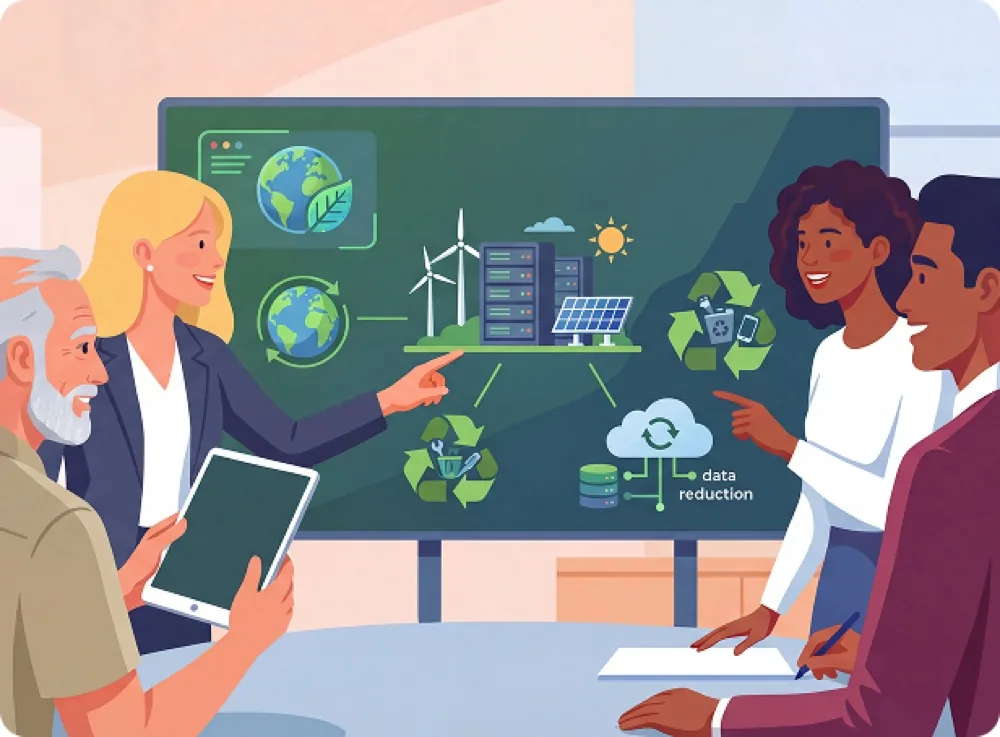
The Digital Collage (Fresque du Numérique in French) is a half-day collaborative workshop: in teams of 4 to 8, participants link cards together to understand the environmental impacts of digital technology, then choose actions. It is a very good format for exploring the topic in depth with volunteers gathered in one place. To get a whole company on board, and especially teams spread across home working, branches and several sites, other formats complement it well: serious escape room, MOOC, quiz, card games or talks.
This article explains how a Digital Collage workshop runs and how to organise one in a company, then gives a fair comparison of the alternatives to help you choose.
What is the Digital Collage (Fresque du Numérique)?
The Digital Collage is a collaborative serious game that helps people understand the environmental impacts of digital technology: device manufacturing, infrastructure, usage and waste. The workshop was created in 2019 by Aurélien Déragne and Yvain Mouneu, who later handed its rights over to the association La Fresque du Numérique. Version 3.0 benefited from the expertise of the association's scientific committee.
The workshop is designed first and foremost for in-person sessions, but a remote format is also possible. All the official information is on the Fresque du Numérique website (in French).
How does a Digital Collage workshop run?
Participants work in teams of 4 to 8 around a table. One facilitator looks after a maximum of 16 participants, split into two sub-groups. The workshop follows four steps:
- Understanding: each team discovers the game cards and draws the cause-and-effect links between them to build its "collage".
- Creativity: participants illustrate their key messages, then choose a title.
- Presentation: each team presents its collage, and the facilitator gives a spoken summary.
- Action: participants go through the Action cards and pick the most relevant actions.
How long does a Digital Collage last? Half a day: according to the association, usually 3 hours in a volunteer setting and 3.5 hours in a professional setting. A short 2.5-hour version exists for in-house sessions, but the association strongly recommends at least 3 hours, especially remotely (Fresque du Numérique FAQ).
How do you organise a Digital Collage in your company?
You have three options:
- Sign employees up for an open workshop: public workshops are listed on the association's website. Handy for a few curious people, less so for a whole team.
- Hire a professional facilitator: for use in a company, the facilitator must have completed the professional facilitation training path and signed a usage contract with the association. Usage fees are paid to the association: €10 excluding VAT per participant in a professional setting, according to its FAQ, on top of the facilitator's fee.
- Train your own facilitators: the association offers a path for employees who facilitate for their colleagues. You first need to have taken part in a workshop, then follow the training. More than 5,300 people have already been trained as facilitators, according to the association's website. The training options are detailed on the dedicated page.
Strengths and limits of the Digital Collage
Strengths:
- The big picture: by linking the cards, participants understand the mechanisms, not just isolated figures.
- Real time for discussion: small groups, exchanges, presentations. Everyone makes the topic their own.
- A recognised framework: content reviewed by a scientific committee and a method shared by a large network of facilitators.
Limits in a company setting:
- Time: half a day is hard to block out for teams with busy calendars.
- Scale: a maximum of 16 participants per facilitator. To reach several hundred people, you need to multiply sessions and facilitators.
- Organisation: finding or training facilitators, booking rooms, putting groups together.
- Distance: the workshop is designed first and foremost to take place around a table. A remote version exists, but the association recommends at least 3 hours for it. For teams working from home, in branches or across several sites, getting everyone together remains difficult.
None of these limits is a flaw in the workshop: they are the price of an in-depth reflection format. They simply explain why many companies combine it with other formats.
Digital Collage and alternatives: the comparison
| Format | What it brings | Limit |
|---|---|---|
| Digital Collage | The big picture of causes and effects, real collective reflection in small groups | Half a day, a maximum of 16 participants per facilitator |
| Serious escape room | People act rather than listen, cooperation is built in, 90 minutes for the team session, 6 to 500 participants at once | Less time for in-depth debate than a reflection workshop |
| Quiz or MOOC (e.g. the INR MOOC) | Free for the INR MOOC, self-paced, reaches many people with no logistics | Little interaction, takes motivation to finish |
| Card games | Short and friendly, easy to fit into a meeting or seminar | Often designed for small groups, depth varies from game to game |
| Talk | Reaches a large audience in one go, adaptable content | Top-down format, little interaction |
The alternatives in detail
The serious escape room: getting everyone on board
Our sustainable IT serious escape room focuses on action and play. The team session lasts 90 minutes in total: an introductory video, a five-stage mission (puzzles, a recap video and a reinforcement quiz at each stage), then a wrap-up and discussion. Participants play in teams of 1 to 4, and a session can bring together 6 to 500 people at once (more on request), online or on site, in French or English.
- Cooperation is built in: in a team, each player holds information the others do not have. Nobody can succeed alone.
- Busting myths: the scenario helps people tell symbolic gestures (deleting an email) apart from the levers that really count, such as keeping devices for longer.
- Sourced content: it draws on work by the IPCC, ADEME, GreenIT.fr and the Institut du Numérique Responsable.
- Customisable: the introductory video can present your sustainable IT strategy, and the game's eco-gestures can reflect your own actions.
- Several formats: as a team over video call, solo, on your premises with a Game Master, as mini-games or as a challenge in episodes. See the formats.
MOOCs and quizzes: a shared foundation, at your own pace
The Institut du Numérique Responsable MOOC is free and open to all. Its awareness module takes half an hour and is available in French and English; a paid certification is offered to those who want to go further. Inria also offers a MOOC on the environmental impacts of digital technology.
MOOCs and internal quizzes are ideal for giving many people a shared foundation. Their limit: without discussion or facilitation, engagement depends on each person's motivation.
Card games and short workshops
Other awareness card games and workshops exist, often shorter than a collage. They are easy to fit into a team meeting or a seminar. Before choosing, check the intended group size, whether a trained facilitator is needed and which sources are used.
Talks: informing widely
A talk given by an expert, usually lasting 45 minutes to 1 hour, reaches many people at once and can focus on a specific topic (eco-design, purchasing, equipment life cycle). It is a good way to launch the topic, but the format remains top-down: it informs more than it gets people acting.
Digital Collage or escape room: why choose?
The two formats complement each other, and location helps decide who does what.
- Where teams are together (head office, off-site, steering committee), the collage is ideal for going deeper with volunteers: sustainable IT ambassadors or the team leading the initiative.
- Where they are not (home working, branches, distant sites, field teams), the escape room takes over: as a team over video call, each from their own desk; solo, whenever suits them; or as a challenge in episodes that everyone plays whenever they like. Everyone has the same experience, with no travel and no room to book.
The most common order: the escape room to get everyone on board, wherever they work, then the collage for those who want to go further. We explain how to organise this in our guide to Digital Cleanup Day for remote and multi-site teams.
A key moment such as Digital Cleanup Day, every year in March, is a good time to combine both. We have gathered 9 Digital Cleanup Day activity ideas, and a guide to the digital eco-gestures that really count at work.
Frequently asked questions about the Digital Collage
How long does a Digital Collage last?
Half a day. According to the association, the workshop usually lasts 3 hours in a volunteer setting and 3.5 hours in a professional setting. A short 2.5-hour version exists for in-house sessions, but the association recommends at least 3 hours.
How many people can take part?
Participants work in teams of 4 to 8. One facilitator looks after a maximum of 16 participants, split into two sub-groups. For a larger group, you need several facilitators or several sessions.
Does the Digital Collage cost money for companies?
In a professional setting, usage fees of €10 excluding VAT per participant are paid to the association, according to its FAQ, on top of the facilitator's fee. Up-to-date terms are on the Fresque du Numérique website.
What is a good alternative to the Digital Collage for a large group?
To raise awareness among several hundred people at the same time, a sustainable IT serious escape room is easier to roll out: 90 minutes for the team session, 6 to 500 participants at once, online or on site. A free MOOC such as the INR's can also lay a shared foundation.
What is an alternative to the Digital Collage for remote or multi-site teams?
A sustainable IT serious escape room can be played as a team over video call, each from their own desk, or solo and as a challenge in episodes for people on shifts. It raises awareness among dispersed teams at the same time, without bringing everyone into one room. The collage can then be offered to volunteers, wherever they meet.
What is the difference between the Digital Collage and an escape room?
The Digital Collage is a collective reflection workshop, in small groups around cards. The escape room focuses on action and play, brings many more people together at once and works just as well for teams that are not in the same place. The two complement each other: the escape room to get everyone on board, across all sites, the collage to go deeper with volunteers.
Want to raise awareness of sustainable IT across your whole company? Contact us to organise a session of our serious escape room.
Read next
See all blog articles Responsible digital training
Digital Cleanup Day for Remote and Multi-Site Teams: Getting Everyone Involved
8 min read
 Responsible digital training
Digital Cleanup Day Challenge: How to Run a Week of Team Challenges
8 min read
 Responsible digital training
Responsible digital and green IT: the complete guide
17 min read

Planning a corporate escape game?
Our experts help you create a turnkey experience, tailored to your needs and your team.
 5/5 from 141+ Google reviews