
Digital Cleanup Day for Remote and Multi-Site Teams: Getting Everyone Involved
By Clément Lemerle, published on
Contents
To get a remote or multi-site company involved in Digital Cleanup Day, focus on actions everyone can take from their own desk (shared drives, mailboxes, cloud storage, video calls) and on a local champion at each site for device collection. Spread it all over the week of 15 to 19 March 2027, with formats that can be played online or whenever suits each person. Here is how to organise that week, team by team.
At a glance: how each team can take part
| Team | What they can do | Suggested format |
|---|---|---|
| Remote employees | Sort files, mailbox, cloud storage and call recordings | Collaborative over video call, challenge |
| Head office | The same actions, plus collection and a highlight event | On site, mini-games on a stand |
| Branches and regional sites | Data clean-up, local collection with a champion | Collaborative over video call, challenge |
| Field teams | Sort their work phone, drop off old devices | Solo, mini-games |
| Shift workers | Challenges open all week | Solo, challenge |
| International teams | The same challenges, in their language | Game in French or English |
Digital Cleanup Day 2027: a week to act, wherever you are
Digital Cleanup Day 2027 takes place on Saturday 20 March, with actions possible from 15 to 20 March (official Digital Cleanup Day website; French website). In France, it is co-run by the Institut du Numérique Responsable (INR) and World Cleanup Day France.
The French website suggests four ways to take part: delete the data you no longer need, repair your devices, give them away (for reuse or recycling) and raise awareness around you. Good news for distributed companies: most of these actions do not require people to be in the same place. Only device collection needs physical organisation, site by site.
Actions that work well remotely
Sorting data is the easiest action to run with remote teams: everyone acts from their own computer, at their own pace. Here is where to look.
Shared drives and cloud storage
This is often where duplicates, old versions and folders from finished projects pile up. Ask each team to tidy its shared space: delete copies, archive what needs archiving, remove the rest.
Be careful: a shared folder belongs to several people. Set a simple rule before the challenge: you only delete what you created, or with the team's agreement. And check with your IT department or records manager which documents must be kept for legal reasons.
The mailbox
Unsubscribing from newsletters nobody reads, deleting emails with heavy attachments already saved elsewhere, emptying the bin: this challenge takes a few minutes, between two meetings. To go further, encourage people to share links to a common document rather than sending attachments.
Video calls and their recordings
Remote teams often record their meetings, and these recordings stay stored long after they have served their purpose. Make it a challenge: everyone deletes the recordings they no longer need. It is also a chance to discuss video call habits as a team.
The work phone
Photos, videos, unused apps: a work phone can be sorted anywhere, including out in the field or on the train. Add a simple tip to make it last longer: a case, a screen protector, and no replacement while it still works.
Keep the orders of magnitude in mind: according to the ADEME-Arcep study on the environmental footprint of digital technology (in French), most of that footprint comes from our devices, and above all from manufacturing them. Sorting data is a good starting point, but keeping devices for longer matters more. Tell your teams, even remotely.
Including branches, field teams and shift workers
In a distributed company, the risk is that Digital Cleanup Day becomes a head office affair. A few simple choices avoid that.
- A champion at each site. In each branch or site, a volunteer passes on the challenges, sets up the collection box and reports the results. They do not need to be an expert: they mainly need to be known and supported.
- Challenges open all week. Shift workers, on-call staff and part-timers will not be there for the kick-off. Each challenge should stay open from Monday to Friday.
- Challenges that work on a phone. Field teams do not always have a computer. Sorting the photos on a work phone or playing in a browser works anywhere.
- Not just by email. A poster in the break room, a word from the manager in a team meeting, a message on your internal chat tool: use several channels to reach people who do not read their emails.
- Collection organised locally. One box per site, two routes (working devices to reuse, the rest to recycling), and a way to move everything: a local partner or a grouped shipment, to be agreed with your facilities team.
- Data wiped before any donation. Devices dropped off must be wiped, and work equipment follows the process set by your IT department.
- The same score for everyone. Count results by site or by mixed team, relative to the number of participants, so that small sites stand a chance against head office.
Online or on site: how to share out the formats
We offer five sustainable IT awareness formats. In a distributed company, the idea is simple: one shared online format to bring everyone together, and independent formats so that everyone can take part at their own pace.
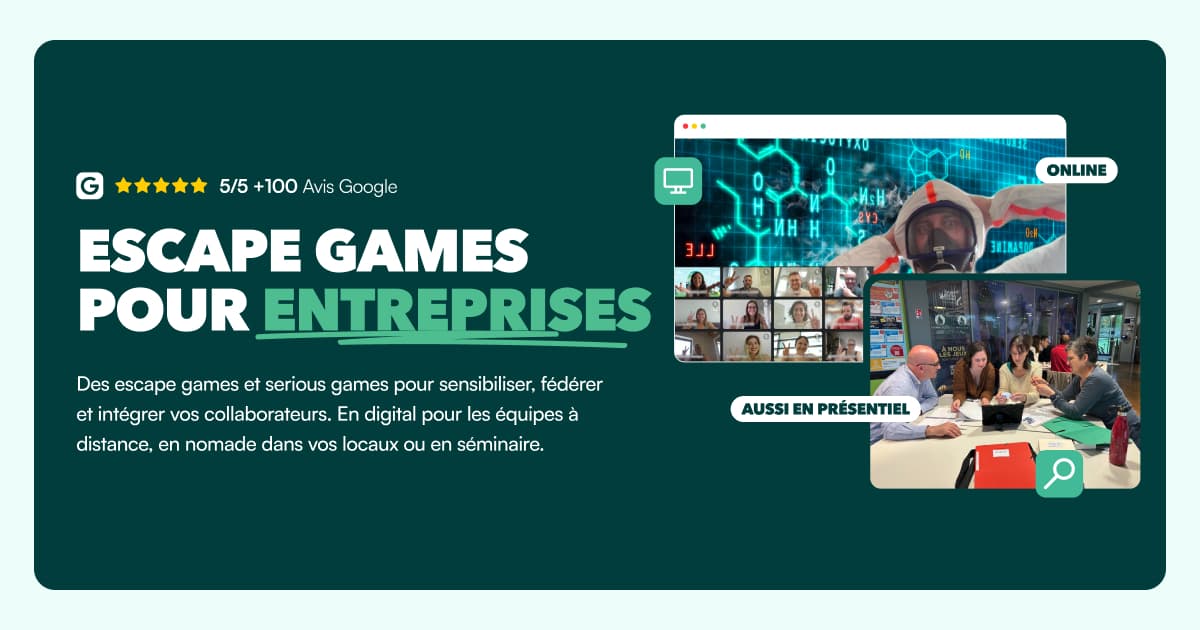
- Collaborative: the team escape room, over video call. Each player holds information the others don't have: nobody can succeed alone. Ideal for kicking off the week with the whole company, even across several sites. Mixing colleagues from head office and branches in the same team creates connections that do not usually exist.
- Solo: each employee plays alone, in their browser, whenever suits them. Ideal for teams on shifts, in branches or out in the field.
- Challenge: based on our Christmas challenge, an escape room in episodes that everyone plays whenever they like. Ideal for keeping Digital Cleanup Day alive all week long.
- Mini-games: short games, played independently, to discover the right sustainable IT habits. Ideal for a stand, a coffee break or your intranet throughout the week.
- On site: the game takes place on your premises, run by a Game Master. Ideal for a highlight at head office or during an off-site.
The game is available in French and English, so international teams can join in. It can also be adapted to your company: the introduction video can present your sustainable IT strategy, and the eco-gestures highlighted can reflect your own initiatives.
A one-week plan for a distributed company
- Monday 15 March: an online kick-off. A message from senior management shared with everyone, then a shared awareness session over video call, open to every site. Each team notes its starting point (the space used in its shared drives, for example).
- Tuesday 16 March: sorting shared data. Shared folders, cloud storage, call recordings, with the rule "you only delete what you created".
- Wednesday 17 March: mailbox and phone. Short challenges that can be done anywhere, including in the field.
- Thursday 18 March: collection at every site. Local champions open the collection boxes; remote employees drop off their devices on their next visit, or take them to a collection point near home.
- Friday 19 March: results for everyone. An announcement over video call or a message to the whole company, site by site, with the shared rules you are keeping after the week.
For details on each challenge, how to build teams and how to measure results, see our guide Digital Cleanup Day Challenge: How to Run a Week of Team Challenges.
Pitfalls to avoid
- Running everything from head office. If branches discover the initiative on Monday morning, they will not follow. Brief local champions several weeks ahead.
- A collection with no logistics. A full collection box left in a corridor for weeks puts everyone off. Decide before Thursday who picks up what, and when.
- Challenges only for people at a computer. Plan at least one action that can be done on a phone or on site for field teams.
- Measuring only gigabytes. Sites with little digital data but plenty of old devices have a lot to contribute too. Count devices collected and participants.
- Forgetting to say thank you. Mention every site in the results announcement, even the smallest.
Frequently asked questions about Digital Cleanup Day for remote and multi-site teams
Can you take part in Digital Cleanup Day fully remotely?
Mostly, yes. Sorting data (files, shared drives, cloud storage, mailbox, call recordings) and awareness work very well remotely. Only device collection needs a physical drop-off point, at the office or near home.
How do you involve branches and regional sites?
Appoint a volunteer champion at each site, give them the challenges and the collection materials in advance, and count results site by site. A shared online kick-off, open to every site, gives everyone the feeling of taking part in the same initiative.
What can you offer field teams and shift workers?
Challenges that stay open all week and can be done on a phone, such as sorting the photos on a work phone. For awareness, the solo format lets each person play alone, in their browser, whenever suits them.
How do you organise device collection across several sites?
One box per site, two routes (reuse for working devices, recycling for the rest) and a transport solution agreed in advance with your facilities team. Data must be wiped before any donation.
Is the game available for international teams?
Yes, the game is available in French and English, so teams in different countries can take part in the same week.
Do you have to choose between an online and an on-site format?
No, they work together. An online format (collaborative over video call, or challenge) brings every site together, and an on-site format creates a highlight at head office. Compare our five formats.
Further reading
- Digital Cleanup Day Challenge: How to Run a Week of Team Challenges
- Digital Cleanup Day: 9 Activity Ideas to Engage Your Company
- How to Reduce Your Digital Carbon Footprint: Eco-Gestures for Responsible Digital Use
- Team building for large groups across multiple sites: a guide to engaging 50 to 500 people
Read next
See all blog articles- Responsible digital training
Digital Cleanup Day Challenge: How to Run a Week of Team Challenges
8 min read
 Responsible digital training
Responsible digital and green IT: the complete guide
17 min read
 Responsible digital training
Digital Cleanup Day 2027: 9 Activity Ideas to Engage Your Company
15 min read

Planning a corporate escape game?
Our experts help you create a turnkey experience, tailored to your needs and your team.
 5/5 from 141+ Google reviews