
Sustainable commuting: the complete guide to soft mobility
By Elsa Baudron, published on
Contents
At a time when environmental concerns and sustainable development are becoming more and more important, it is essential to rethink the way we get around. To encourage people to adopt sustainable commuting habits, government decisions and initiatives taken by companies are a real pillar.
I. Sustainable commuting (soft mobility): definition
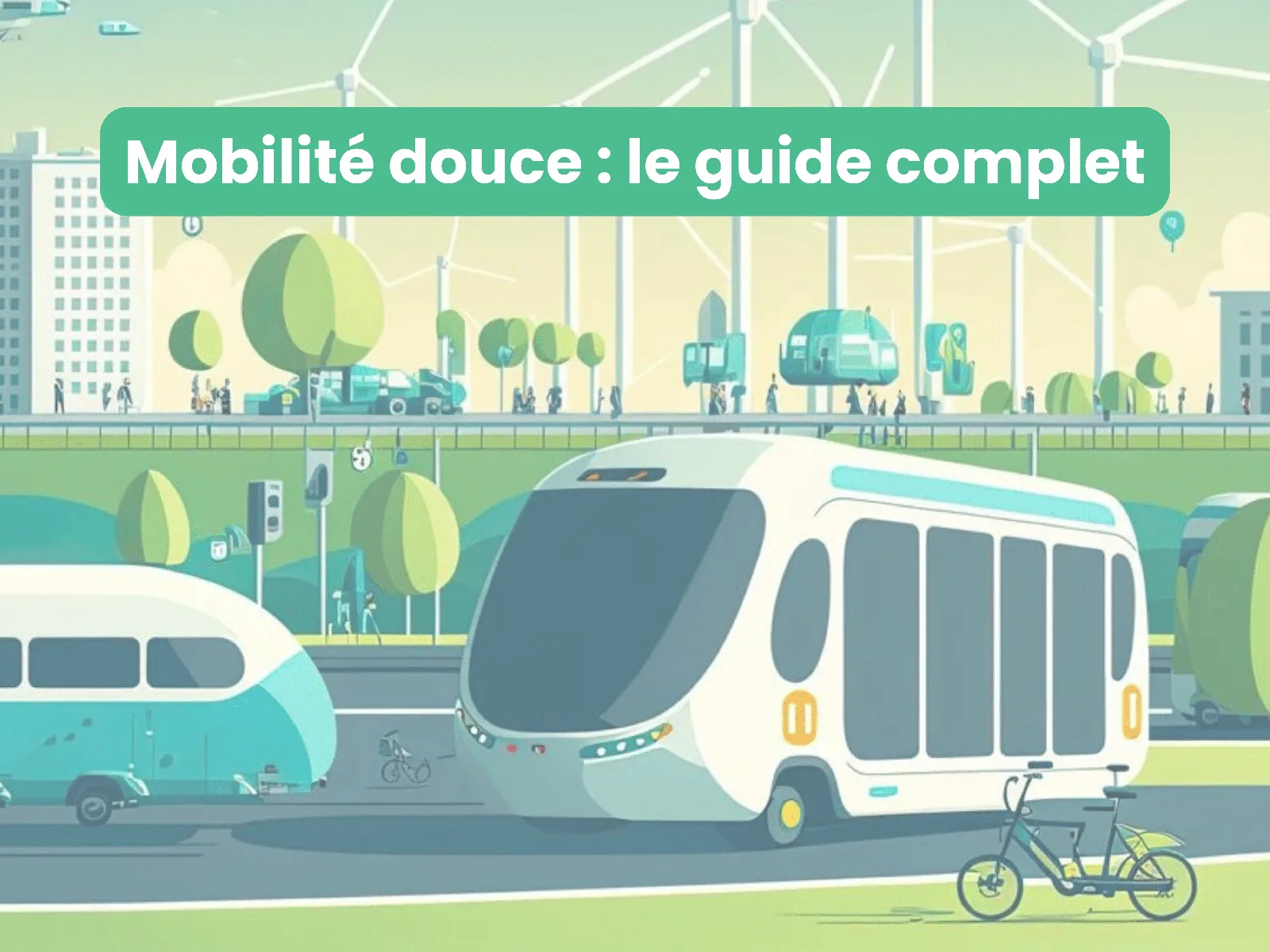
Soft mobility, also called sustainable mobility, refers to all forms of sustainable travel, mainly in urban environments. It covers means of transport that produce few or no polluting emissions, which helps reduce air pollution and noise as well as urban congestion.
Sustainable mobility is now a top priority in the fight against climate change. Indeed, transport remains the main source of CO2 emissions, accounting for 32% of France's total emissions (Les Echos). Soft mobility is therefore part of the many environmental challenges we face today.
II. What types of soft mobility are there?
There are many types of soft mobility! They include walking, cycling, electric vehicles (cars and scooters), public transport (buses, trams, trains) and other sustainable options such as carpooling or car sharing.
Here is some information on each of these modes of transport:
Walking: in France, walking is the second most common daily mode of transport after the car. For 24% of French people, walking is the main daily mode of transport (Webzine voyage). However, walking habits differ a lot with age. Walking accounts for 33.9% of trips made by people under 18 and 32.5% of those made by people over 65, while only 15.3% of trips made by people aged 45 to 54 are on foot (French Ministry of Ecological Transition). In general, when people have the option of driving, they do.
Cycling: in 2022, more than 700,000 people used a bicycle to commute to work. That share is still marginal compared to car use. According to a survey by Statista in 2022, 71% of respondents most often used the car (or carpooling) for their daily trips, while only 12% answered the bicycle, which came after the car, walking and public transport.
Electric vehicles: electric mobility has seen a real upward trend over the past 10 years! The share of electric vehicles is still small compared to the whole car fleet, but it keeps growing. In 2010, there were only 102 electric vehicles on the road, compared to 882,531 in 2023 (Ekwateur). This exponential growth comes from the fact that the French government aims for 100% electric cars by 2035. To get there, the State has introduced, for example, the retrofit bonus (financial aid to convert a car's combustion engine into an electric one) and the ecological bonus (financial aid for buying an electric vehicle).
Public transport: it is already widely used, with 15% of employed people taking public transport. However, this percentage varies a lot depending on where the study is carried out. In the Paris area, for example, 42% of working people use public transport. In contrast, rural areas are left behind by transport networks. French people would like infrastructure to be developed even further. In 2021, 89% of French people still considered it necessary to develop public transport (Observatoire de la Mobilité 2021).
Carpooling and car sharing: be careful not to confuse the two! Carpooling is the practice of sharing a vehicle between several people going to the same destination or following similar routes. Car sharing is a short-term car rental service where users rent vehicles for limited periods, often by the hour or by the day. Both practices are growing fast. More than one million carpooling trips were made through platforms in March 2023, which is 3.5 times more than in March 2022 (Ministry of Ecological Transition and Territorial Cohesion). As for car sharing, the increase in its use is impressive! It grew by 43% in just one year.
III. The benefits of soft mobility
There are so many alternatives to polluting trips for a good reason! Soft mobility has many benefits. It allows a lower environmental impact by keeping pollution in check, brings economic advantages, and also leads to better health and well-being.
Soft mobility and environmental impact
Soft mobility produces few or no greenhouse gas emissions, which helps reduce air pollution and protect the environment. It also avoids traffic jams, which are themselves a source of even more pollution.
Soft mobility and economic benefits
Soft mobility often saves money, especially when you would otherwise drive alone! When they use their car, employees face significant costs for fuel, maintenance and parking. Using another means of transport can be a real way to save money. According to Statista, in 2018, 41% of French people said they used public transport to save money. Driving costs 16 times more than taking a bus, train, metro or tram if you live outside Paris. For a Parisian, using a car costs 7 times more (Le Parisien).
Soft mobility and health
When people use soft mobility such as cycling or walking, they make a direct physical effort that improves their overall health. Many studies have looked at the benefits of cycling! According to a Danish study from 2016, cycling every day reduces the risk of developing type 2 diabetes by 20%. A 2017 study from the British Medical Journal found a 46% reduction in the risk of heart disease and a 45% reduction in the risk of developing cancer.
Beyond health, well-being is also positively affected! The bicycle is the means of transport that brings the most happiness! And if you are an employer, you should know that the productivity of employees who exercise regularly increases by 6 to 9%.
Finally, health and well-being also improve simply because you do not pollute. Air pollution goes down, which reduces respiratory problems. Soft mobility also reduces noise pollution, which is often a source of stress.
IV. Challenges and solutions
Soft mobility clearly has many benefits, but it is not that easy to put in place. Promoting it faces many challenges.
First, there is a critical lack of infrastructure, especially in rural areas. There are far more bike lanes, public transport lines and public charging stations in big cities like Paris than elsewhere in France. While "only" 47% of trips in Paris and its suburbs are made by car, in rural areas it is 74% of trips! These figures show how much the lack of infrastructure affects the adoption of greener ways of getting around. To ensure a fair transition to sustainable mobility, it is essential to consider every situation, including the most remote areas. Mobility must be accessible to everyone.
Even before making this kind of mobility easy to access, we need to raise public awareness, starting at a very young age. It can be worthwhile to create mobility awareness kits for children and to talk to them about the importance of cycling when they learn to ride. Launching small challenges with rewards can make children want to learn more about the topic! To raise awareness as widely as possible, long-term support is needed, which is why we must keep raising awareness, even at work!
Another solution to consider is technological progress! Many start-ups are betting on it to promote smart mobility. The company Matawan, for example, created a mobility SaaS platform to manage transport networks in real time, connect them and give the means to optimize them. The company 1 km à Pied helps reduce commutes. With HR software, it can analyze the existing commutes of employees, so employers can then redirect their staff to sites closer to home.
V. Sustainable commuting at work: how to put it in place
Government policies that support soft mobility
Government policies have been introduced to make it easier to implement soft mobility in companies. Here is a summary of the schemes and rules you should know about (all of them apply in France):
The Mobility Orientation Law (Loi d'Orientation des Mobilités, LOM): this law, enacted in 2019, makes it possible to invest in everyday transport while making it easier to use, in order to start the transition to cleaner mobility. For companies, the LOM law encourages mobility plans for employees, for example with incentives for remote work and the use of soft modes of transport.
The Sustainable Mobility Package (Forfait Mobilité Durable, FMD): this is a financial support scheme for private sector employees and public service staff for their commute. An employee can receive €800 per year, which can be combined with the public transport allowance. In other words, an employee can have at least 50% of their public transport pass covered and also benefit from the €800.
Bicycle mileage allowance (Indemnité kilométrique vélo, IKV): this is an optional scheme created by the energy transition law that allows the employer to cover the transport costs of employees who commute by bike. The bike allowance is €0.25 per kilometer, up to a maximum of €500 per year per employee in the private sector (€200 in the public sector).
Greening company fleets: when fleets are renewed, a share of at least 10% low-emission vehicles is mandatory.
Initiatives to take at your company
Putting soft mobility in place does not depend only on government policy. Companies' CSR initiatives also play a very important role in this process. According to Welcome to the Jungle, 29% of French employees see the company as one of the main players in the transition to eco-mobility. Every company can set up its own measures to create an environment that supports soft mobility. They can be infrastructure as well as financial incentives.
Set up infrastructure that supports soft mobility. Since sustainable commuting often involves physical effort, it may be necessary to provide showers so employees can freshen up before sitting at their desks. To encourage carpooling, priority parking spaces for carpoolers can be created.
Set up software to build a carpooling community among your employees, and with nearby companies. Employers can collect each employee's place of residence and departure time to see whether a carpooling system is feasible. If there are not enough employees traveling to the same place, it can be worthwhile to extend this network to neighboring companies.
Offer financial incentives and flexible hours. Every company in France must reimburse at least 50% of the cost of the public transport pass needed to get to work. However, depending on how much importance you want to give to sustainable mobility, you can raise this reimbursement rate. To encourage employees further to take public transport, it may also be necessary to review their arrival and departure times. Many people do not use public transport because they want to avoid rush hour. By offering your employees a more flexible schedule, you let them finish at a time when fewer people are on public transport.
Review your business travel policy. Business travel causes many polluting trips. It is therefore necessary to assess how important each one is. Is it really essential to visit the client in person, or can it be done by video call? Depending on whether the trip is necessary, try to favor remote meetings. When the trip is far and required, make sure your employees take the train rather than the plane. You can offer financial incentives as well as schedule adjustments.
Did you know? Some companies have introduced Responsible Travel Time (Temps de Trajet Responsable, TTR), that is, extra days off so employees have time to travel responsibly. In practice, it means two extra days off (or rather "semi-off" days if the Wi-Fi allows it) if the traveler can show proof they went by train or carpooled. This scheme gives employees the time to make an eco-friendly trip.
Encouraging community engagement
Beyond the measures to put in place, it is important to create a sense of belonging to a community to encourage collective engagement. To do this, everyone needs to feel concerned by environmental issues. Here are a few examples:
- Rely on themed days. Dedicating a day to eco-mobility lets your employees learn more about the topic while spending time together. You can run days with broad themes such as "Bike Day" or, on the contrary, more specific themes such as "Mobility Orientation Law (LOM) Day". The more workshops you run around eco-mobility, the more your employees will want to follow you in this approach!
Here are some examples of activities for a day dedicated to cycling:
Bike repair stand: how many of us have left our bike aside since it got damaged? Calling in a repairer can bring back the motivation of former cycling regulars! 😀
Visit from an electric bike company: for those who are less used to it, this is the perfect time to think about switching to a bike! By contacting a company that could let people test its bikes on a course, your employees could better imagine using this mode of transport.
Awareness workshop: contacting a local group of cycling enthusiasts who talk about the benefits of cycling will give even more credibility to your commitment!
Create awareness campaigns. You can communicate to highlight employees who already use soft mobility. For example, you can print a photo of one of your employees and write a few lines about them to showcase their commitment. Display this portrait in a high-traffic area of your company so that as many employees as possible see it. Seeing some employees valued will make others want to get involved in the same way. You can even widen your impact by publishing a LinkedIn post to show that cycling to work really matters more and more!
Create challenges within your company. We all know that when there is a competition with a prize, it is easier to attract motivated people! So why not create contests between your employees? For example, you can set a challenge for the employee who manages to carpool with the most people, or a competition encouraging everyone to sort their waste as well as possible. A competition can create this community spirit by pushing everyone to do their best!
Serious games: a fun way to capture your employees' attention. Have you ever tried serious games? They make serious content more engaging through fun, educational goals! This is the case for escape games, which can be played online (to avoid polluting trips 😉) or on site. They tend to hold your employees' attention thanks to a more "fun" and active way of tackling very serious topics. You can run escape games on Responsible Digital or on disability in the workplace. Puzzles to solve together, videos, quizzes... a range of activities that will easily engage your employees! So, ready to raise awareness in a good mood?
For more information, you can contact us at The Wokies.
VI. Conclusion
The future of soft mobility depends on everyone's involvement! Government decisions and company initiatives have a central role to play in raising citizens' awareness. These players act as awareness-raisers, because in reality it is mostly personal actions that protect the environment. Without the involvement of communities, we cannot move toward a sustainable future.
Read next
See all blog articles


Planning a corporate escape game?
Our experts help you create a turnkey experience, tailored to your needs and your team.
 5/5 from 141+ Google reviews